
Part 2 of 3 in a series on the GTM mistakes I see again and again. Part 1: More leads won’t fix a leaky funnel. Part 3: New logo obsession.
Every company has at least one ICP. It’s in a slide somewhere, usually beautifully designed.
Then the last month of the quarter hits. Pipeline is thin. People are getting desperate to hit their quota.
A deal shows up from a company that’s nowhere near your ICP, but they’re keen, and they’re willing to pay.
Saying no feels like leaving money on the table. So you say yes.
And slowly your ICP stops meaning Ideal Customer Profile and starts meaning I Can Pay.
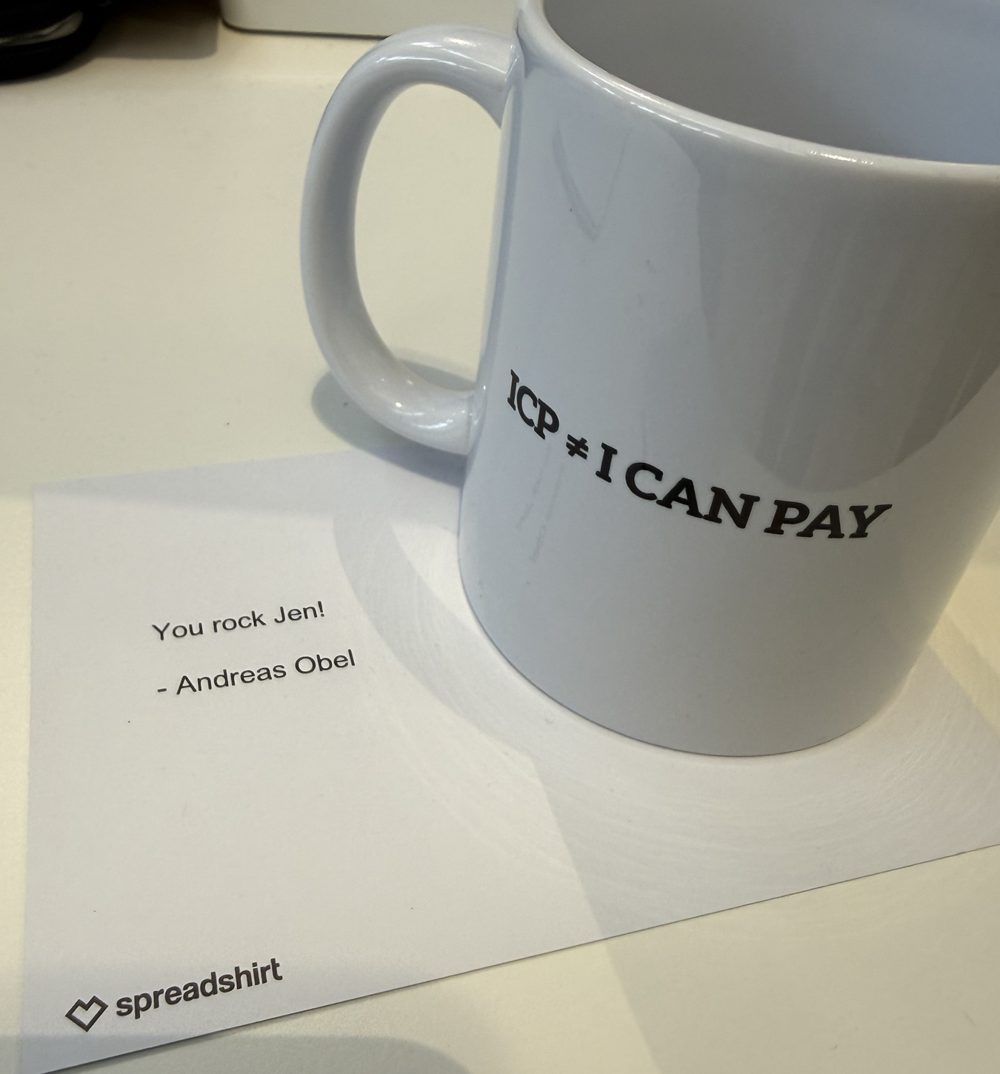
What does a loose ICP cost you?
It doesn’t show up where you’re looking. A loose ICP looks GREAT at the top of the funnel. More MQLs, more meetings, a busy pipeline. Marketing hits their targets - HURRAH!
The damage shows up later, when sales tries to close those deals and when they become customers.
Here’s the same team, with the same people and the same effort, working two different ICPs (conversion rates taken from B2B benchmark).
What happens before the deal closes?
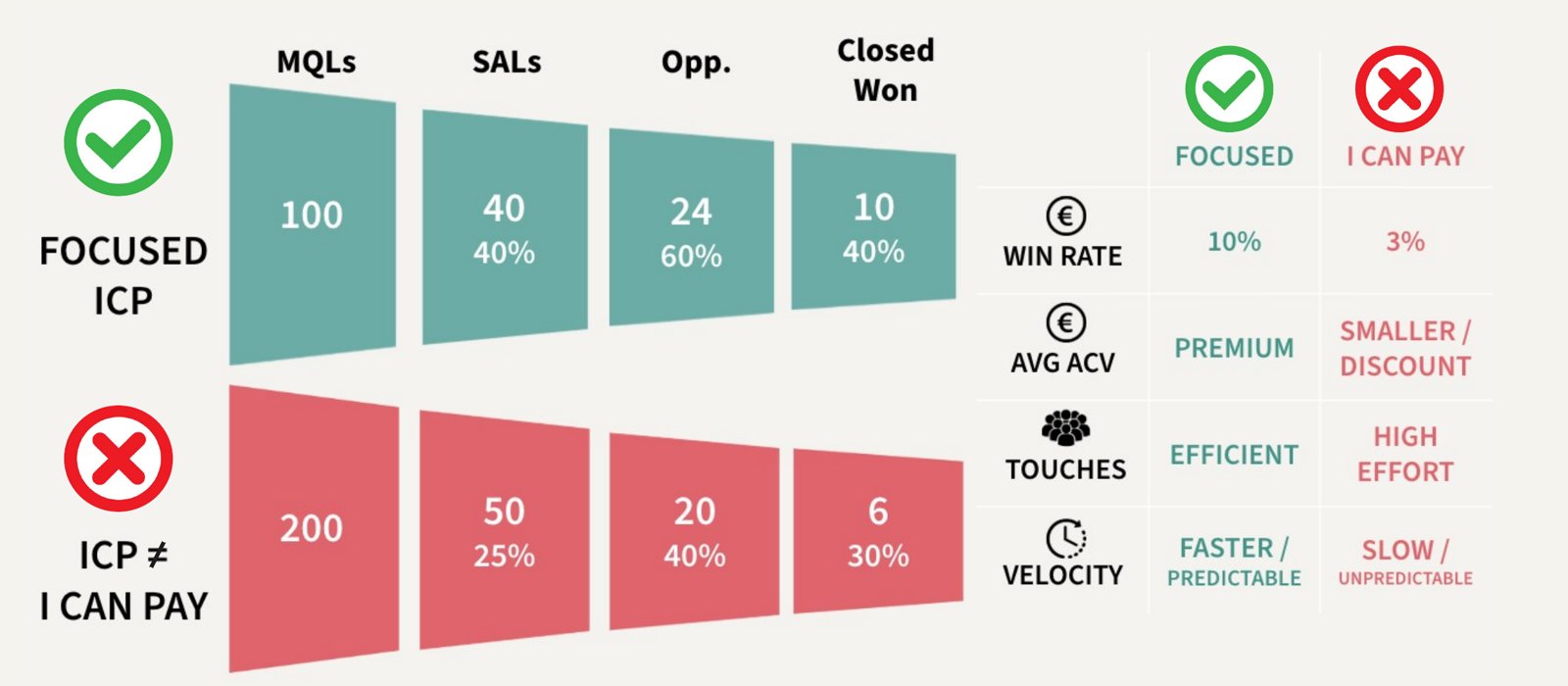
Focused ICP
- 100 MQLs
- 40 SALs (40%)
- 24 opportunities (60%)
- 10 closed won
- Win rate: 10%
Loose ICP (I Can Pay)
- 200 MQLs
- 50 SALs (25%)
- 20 opportunities (40%)
- 6 closed won (30%)
- Win rate: 3%
Twice the MQLs. More SALs. On the Monday dashboard, I Can Pay is winning.
WHY?: When that deal gets to sales, out-of-ICP buyers need more touches and more convincing. The deals take longer and are harder to predict. When they do close, they tend to close smaller, or at a discount, because the value wasn’t obvious enough to pay full price.
So the team works twice the leads and closes fewer, smaller deals.
What happens after the deal closes?
This is where it really shows.
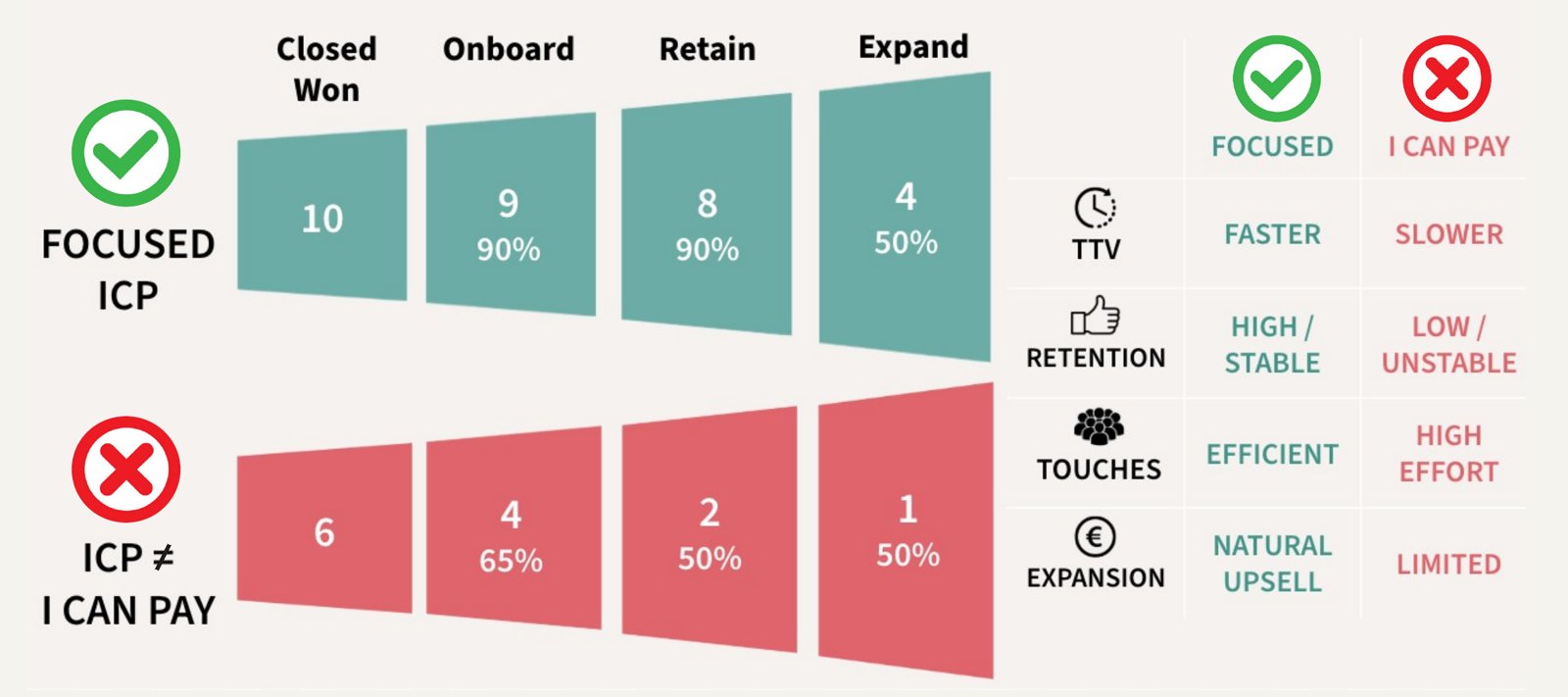
Focused ICP
- 10 closed won
- 9 onboarded (90%)
- 8 retained
- 4 expanded (50%)
Loose ICP (I Can Pay)
- 6 closed won
- 4 onboarded (about 65%)
- 2 retained (50%)
- 1 expanded (50%)
Out of 200 MQLs, the I Can Pay team ends up with two customers it keeps and one that grows.
The focused team, from half the MQLs, keeps eight and grows four.
WHY?: Customers outside your ICP take longer to get value, need more hand-holding from customer success, churn more and rarely expand. Your CS team burns out supporting customers who were never a good fit, while the good-fit customers get less of their time.
Why does this happen in good companies?
Because the pressure is real. Targets are set on new ARR, pipeline reviews are weekly, and nobody gets a bonus for the deal they turned down.
In PE-backed companies, the value creation plan often adds to that pressure. A thin quarter makes almost any deal look attractive.
The cost lands on a different team, in a different quarter. Marketing and Sales hit their numbers, CS inherits the churn, and by the time it shows up in net revenue retention, nobody connects it to the deals that came in nine months earlier.
How do you keep the ICP honest?
- Build your ICP from your best customers across their buyer and customer journey - not just who closed quickly. (It is called Ideal CUSTOMER profile, after all!) Look at who closed fastest, onboarded smoothly, stayed and expanded.
- Track conversion by segment. If you measure in-ICP and out-of-ICP deals separately, the gap above becomes visible in a quarter or two. If you don’t, it hides in the averages. (See part 1 for why the averages lie.)
- Make exceptions a decision. An out-of-ICP deal can be the right call. Make it a conscious one, signed off with eyes open, before the quarter-end rush makes the call for you.
- Expand on purpose. Moving into a new segment is a strategy. Give it its own targets and budget, and judge it on its own numbers.
The takeaway
A loose ICP means working harder for worse outcomes across the whole funnel. It looks good early, then it breaks later, and the team that pays for it is rarely the team that signed the deal (and got the commission).
If you’re seeing high pipeline and low retention in a portfolio company, the ICP is one of the first places I’d look. Let’s talk.
This series is based on my talk “Top 3 GTM Mistakes Killing Your Growth”, given at SaaSiest and Growthforia in 2026. Next: New logo obsession.