
I’ve just finished a guest session with the Winning by Design Growth Institute on a question I think every leader should be asking.
I’m sure you’ve been told you need to implement more AI. And it’s fast becoming a commodity: the same models, the same agents, the same tools, available to everyone.
So if everyone has it, what’s actually your advantage?
The short version: your advantage is the diligence you do before any AI goes in. Know the problem you’re solving. Know your data is reliable. Know how you’ll measure it. Know who owns it. Get all four right and AI compounds what you already do well.
Why do companies skip the diligence?
In a previous role, I supported a portfolio of more than 100 B2B companies, and part of that included supporting AI adoption.
In PE, we’d never consider acquiring a company without running full due diligence. And yet companies buy AI tools, and strip out mission-critical infrastructure to rely on these shiny objects, without doing any diligence of their own.
Everyone wanted to “do an AI”: Chatbots. AI SDRs. Outsourcing all content to AI. There was no shortage of ideas of what they wanted AI to do. That was the easy part.
The hard part? Getting any of them to explain why they wanted to implement AI.
I call it “random acts of AI”.
So here are the four AI due-diligence questions I’d ask before any AI investment.
1. What problem are we actually solving?
Sure, it sounds simple enough. But understanding the problem you’re trying to solve is a lot harder than it sounds.
For example, one company I advised wanted AI to generate more leads. According to them, Marketing was the problem. What did they want AI to do? Generate more leads.
When we ran the full funnel, we saw that while that company had an MQL to SQL conversion rate of over 30%, the conversion rate from SQL to closed won was only 6%.
(For context, First Page Sage puts SQL to closed won at around 12% for B2B SaaS).
So, let me ask you. Is this a Marketing problem?
No. The leak was in the middle of the funnel, not the top of the funnel (read more in More leads won’t fix a leaky funnel).
In this case, buying and implementing an AI lead-gen tool would most likely have been a waste of money. This company would just have poured more leads (and money) into the same leaky funnel, never really solving their problem. What they needed was help for sales enablement and coaching. The right tool for the right job.
The takeaway: before you decide to “do an AI”, find out where the problem actually is. That means looking at your whole go-to-market, beyond acquisition (I swear by Winning by Design’s bowtie model for this). When PE firms buy and sell companies, buyers look at a range of metrics, including net revenue retention, gross retention and CAC payback as well as new logos. So your biggest problem might not sit at the top of the funnel at all. It might be in the middle, or after the sale.
Understand the problem first. Then pick the AI that solves it.
2. Is our data reliable?
We tried to roll out AI workflows across 12 portfolio companies in about eight months. Every single time, we were held up by unreliable data. Sound familiar? Well, we’re not alone: in February 2025, Gartner predicted that through 2026, “organizations will abandon 60% of AI projects unsupported by AI-ready data.”
This matters even more as we are increasingly relying on AI. Remember the good old days when you had to read an actual dashboard, or look at the numbers natively in the platform? More and more, an AI reads them, and even interprets them, for us. Every layer puts us one step further from the source of truth, so we have to be able to trust what comes out.
For example, one company was a merger of two brands: one using Pipedrive CRM, one on HubSpot. My recommendation was simple: bring the entire company onto one CRM, apply the bowtie metrics, then put AI on top to optimise each stage.
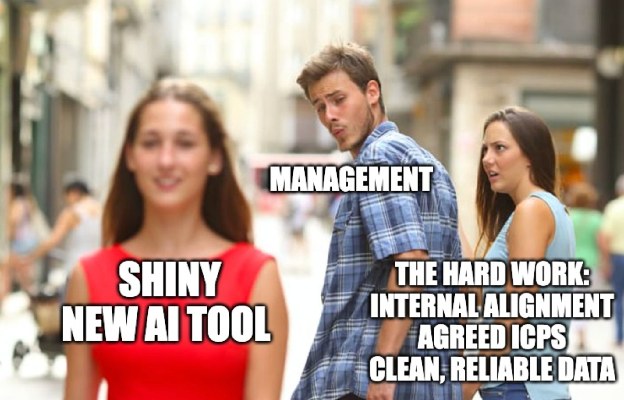
But they wouldn’t budge. Each entity wanted to keep the system it was used to. Instead of merging into one CRM, aligning the data and applying AI on top (aka “the hard work”), they opted for the “easy” route: they built a Frankenstein’s monster of patches across different tools, with dashboards trying to read and interpret different data. Everything became extremely unreliable very quickly, and a lot of time and money was wasted.
The takeaway: I’m not saying wait for perfect data. That’s the best way to never start. But I am saying do the hard work: internal alignment across teams, shared targets, agree on ICPs (see ICP ≠ I Can Pay), and clean the data your first use case needs (hint: you can even have AI help you with that). Because if you can’t trust what goes in, you definitely can’t trust what comes out.
3. How will we measure it?
Once you know the problem and your data is reliable, pick the KPI you’re trying to move. Sales efficiency? Marketing performance? Internal efficiency?
Then set a baseline before you start, a snapshot of where those metrics are today, so you have something to compare against after applying AI to improve it.
Please, I’m begging you: don’t buy one tool that promises to do everything. Treat AI implementation like an A/B test: test one thing at a time, see if it works, and if it does, then scale.
In 2025, MIT’s NANDA initiative found that only about 5% of AI pilot programmes achieve rapid revenue acceleration, while “the vast majority stall, delivering little to no measurable impact on P&L” (as reported by Fortune). And the startups that got it right? According to the report’s lead author, they “pick one pain point, execute well”.
A good rule: run your AI test for 90 days and then measure the relevant KPIs against your original baseline. If it hasn’t moved things significantly, cut or adjust. If it has, scale.
Considering nearly half of the AI tools launched in 2025 were dead within 18 months (Spark, 2026), would you risk your critical infrastructure and core operations on something that might not last? Nah, me neither.
The takeaway: know the number you’re trying to move before you buy anything, and give AI 90 days to move it. If you can’t show what it changed, you can’t defend the budget, and you can’t tell a good tool from an expensive waste of time.
4. Who owns it?
This one always comes up. CEOs say “go do an AI”, but nobody’s quite sure who’s in charge. I’ve often seen AI implementation sit with engineering, because they’re usually the most technically capable. But if it’s a commercial metric you’re hoping to improve, an owner without a commercial mindset can create bottlenecks, reinforce silos and leave everyone with different expectations of what success looks like.
But owning the initiative isn’t enough. Someone also needs a view across the whole business, to see which initiatives work and scale them.
At a small company, that can be one named person and a monthly review.
At scale, I suggest setting up a cross-functional AI board, where leaders from commercial, tech, legal, compliance and operations approve, track and measure every AI initiative. This does three jobs:
- Breaks down silos. Everyone can see what’s being tested where, so two teams don’t buy two tools to solve the same problem.
- Keeps spend and decisions under control. One AI registry shows every tool, who uses it, what it costs and who signed it off. Usage-based pricing adds up fast: I know companies that are already rationing their AI tools.
- Scales what works. When a pilot beats its baseline in one team, the board can roll it out across the business, so it doesn’t stay stuck in a silo.
I’ve seen what happens without oversight. One company I supported gave everyone a Lovable account. Lots of amazing things were being built (good!). But nobody was managing them, not everyone was using them after they were built, and tokens and time were burning fast (bad!).
It’s a delicate balance. Too much red tape and nobody moves. Too little and it’s the Wild West. Keep the AI board light enough that good ideas still move fast.
It also pays to get leadership involved. McKinsey’s 2025 State of AI survey found that a CEO’s oversight of AI governance is one of the elements “most correlated with higher self-reported bottom-line impact” from gen AI. Yet only 28% of respondents said their CEO is responsible for overseeing it. So the same CEOs saying “go do an AI” often aren’t the ones owning it.
The takeaway: give every AI initiative a named owner who knows the metrics, and give the business one place where every initiative is approved, tracked and measured. Without both, you’re back to random acts of AI.
The main takeaway
In sports, a team of superstars running in different directions loses to a team that executes the fundamentals flawlessly. AI works the same way.
AI amplifies whatever you give it. Give it strong foundations and it compounds them. Give it shit data and you get more shit, faster.
And most importantly, keep the thinking for yourself. Harvard Business Review ran an experiment with nearly 300 executives and managers forecasting Nvidia’s share price. The ones who used ChatGPT got more optimistic and more confident, and made worse predictions than the ones who relied on their own experience and judgement. Just sayin’.
If everyone has the same AI, your advantage is knowing the problem, the data, the measure and the owner. Do the diligence first. Then use AI to amplify what you know.